
alphconsultingengineersindia
- Posted on
Know about Routes & Pathways to become MRICS
Table of Contents

The Royal Institution of Chartered Surveyors (RICS) is a globally recognized professional body that sets and upholds standards within the real estate and built environment sector. Established in 1868, RICS has a rich history of promoting excellence, integrity, and professionalism among its members.
Why MRICS Matters?
MRICS stands as a leading global chartered qualification. It has a transformative impact on employability and career progression. Recognized as a hallmark of excellence by employers worldwide, achieving MRICS status is akin to obtaining a global passport for professionals in various domains such as quantity surveying, property valuation, project management, real estate consultancy, and more.
MRICS - The Credibility Seal
The three powerful letters – MRICS – carry a weight that extends far beyond the realms of a mere qualification. They signify credibility, excellence, and a commitment to professional growth. When these initials grace your visiting card, they become a testament to your dedication and proficiency in your field. Employers, regardless of geographical boundaries, actively seek professionals adorned with RICS qualifications, recognizing the rigorous standards and expertise that come with the MRICS designation.
MRICS- The Global Passport for Professionals
MRICS is considered a global passport for quantity surveyors, property valuers, project managers, real estate consultants, and other related professions. The international recognition of this qualification opens doors to opportunities worldwide, allowing professionals to explore diverse markets and contribute their expertise on a global scale.
Navigating the MRICS with RICS APC
The Royal Institution of Chartered Surveyors (RICS) has meticulously outlined the pathway to achieving the coveted MRICS designation through the Assessment of Professional Competence (APC). Referencing the comprehensive “associate-progression-candidate-guide,” we’ll explore the five distinct gateways that pave the way to MRICS, offering professionals a clear roadmap for their career advancement.
Gateways to MRICS
1. RICS-Accredited Degree:
Candidates with an RICS-accredited degree follow a structured route, ensuring they meet the specified criteria for each stage of the APC process.
2. Non-RICS-Accredited Degree or Approved Professional Body Membership:
This gateway caters to individuals with diverse educational backgrounds. Whether possessing a non RICS-accredited degree or membership in an approved professional body, candidates can navigate their way to MRICS.
3.In a Senior Management or Expert Specialist Position:
Professionals holding senior management or expert specialist positions can leverage their practical experience, demonstrating competence in their field to progress towards MRICS.
4.Degree and in an Academic Position on a Degree-Level Programme :
This gateway accommodates individuals with both a degree and an academic position on a degree-level programme, allowing them to channel their academic and practical expertise toward MRICS qualification.
5.No Degree or Approved Professional Body Membership :
Even without a formal degree or approved professional body membership, individuals can embark on the MRICS journey by showcasing substantial experience and competence in their domain.
Visualizing the Pathway
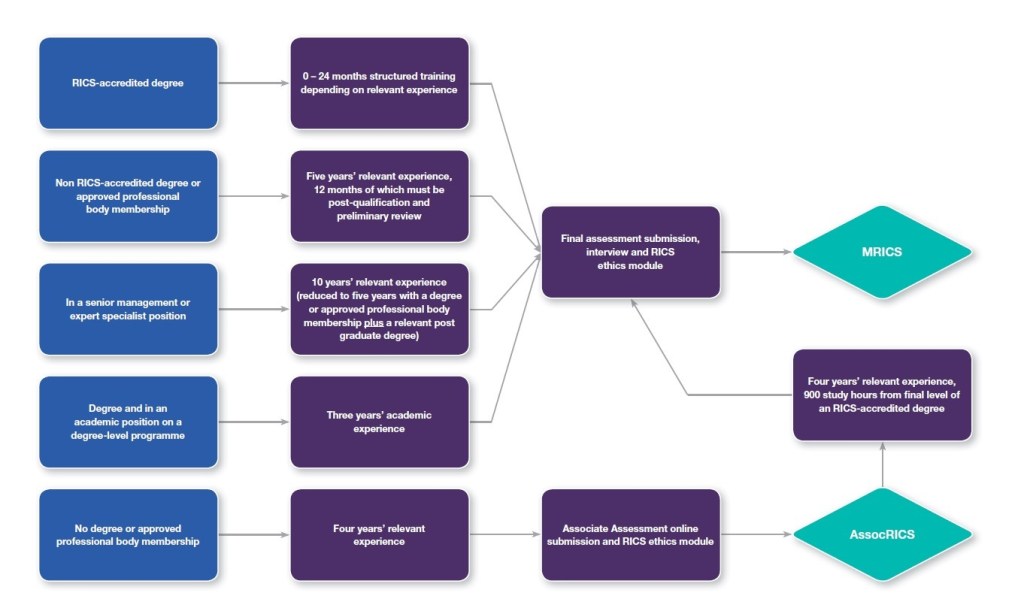
Reference: Associate Progression Candidate Guide August 2021 by RICS
Know your Pathways as per your competencies
In the context of becoming a Member of the Royal Institution of Chartered Surveyors (MRICS), a “pathway” refers to a specialized route or career trajectory that individuals can follow to achieve MRICS status. These pathways are designed to cater to specific professional domains within the built environment and real estate sectors. Choosing a pathway allows individuals to focus on the technical competencies and experiences relevant to their field, ensuring a targeted and comprehensive preparation for the Assessment of Professional Competence (APC) and, ultimately, MRICS qualification. Each pathway defines a unique set of competencies and requirements, providing a clear roadmap for professionals to navigate on their journey to becoming a chartered surveyor. It is suggested to contact the RICS candidate support team to select your pathway. The below table provides an overview of the competencies required.
| Pathway | Overview of technical Competencies required |
|---|---|
|
Quantity Surveying |
Commercial management (of
construction works) or Design
economics and cost planning, Construction technology and
environmental services, Contract practice, Procurement and tendering, Project finance (control and reporting), Quantification and costing
(of construction works) |
|
Project Management |
Contract practice, Development/project briefs, Leading projects, people and teams, Managing projects, Programming and planning, Construction technology and environmental services, Procurement and tendering, Project finance |
|
Valuation |
Inspection, Valuation, Measurement |
|
Building Surveying |
Building pathology, Construction technology and
environmental services, Contract administration, Design and specification, Inspection, Legal/regulatory compliance, Fire safety |
|
Rural |
Agriculture, Management of the natural environment and landscape, Property management, Valuation |
|
Infrastructure |
Engineering science and technology, Client care, Contract practice, Cost prediction and analysis, Procurement and tendering, Programming and planning, Project controls, Quantification, costing and price analysis, Risk management |
|
Minerals & Waste Management |
Minerals management or Waste
management, Legal/regulatory compliance, Environmental assessment, Environmental audit (and monitoring), Ground engineering and subsidence, Inspection, Landlord and tenant, Local taxation/assessment, Planning and development management, Surveying and mapping, Valuation |
|
Facilities Management |
Asset management, Business alignment, Client care.
Legal/regulatory compliance, Maintenance management, Performance management, Procurement and tendering, Project finance, Supplier management, Workspace strategy |
|
Personal Property/ Arts & Antiques |
Object identification, Research methodologies, and techniques, Valuation, Auctioneering |
|
Land and Resources |
Access and rights over land, Agriculture Big data, Cadastre and land administration, Client care, Compulsory purchase and compensation, Land use and diversification, Landlord and tenant, Legal/regulatory compliance, Management of the natural environment and landscape etc. |
|
Environment |
Environmental management, Legal/regulatory compliance, Consultancy services, Contaminated land, Environmental Assessment, Environmental audit (and monitoring), Environmental science and processes, Inspection, Management of the natural environment
and landscape, Planning and development management |
|
Geomatics |
Cadastre and land administration, Conflict avoidance, management and
dispute resolution procedures, Engineering surveying, Geodesy, GIS, Hydrographic surveying, Legal/regulatory compliance, Measurement, Remote sensing and photogrammetry, Surveying and mapping, Surveying land and sea , Use of the marine environment
Plus, Measurement |
|
Residential Property |
Building pathology, Housing maintenance, repairs and
improvements, Housing management and policy, Housing strategy and provision,
Inspection, Leasing and letting, Legal/regulatory compliance, Market appraisal, Measurement, Property management, Purchase and sale, Valuation |
|
Planning & Development |
Development appraisals, Planning and development management or Spatial planning policy and infrastructure, Legal/regulatory compliance, Valuation, Surveying and mapping, Measurement |
|
Building Control |
Building control inspections, Fire safety. Inspection, Legal/regulatory compliance |
Apart from the mentioned pathways, there are numerous other routes available to attain MRICS status. It’s important to recognize that the competencies required for each pathway are highly specific, and RICS frequently updates them in the relevant pathway guides. For the most accurate and up-to-date information, it is advisable to consult with your counsellor or refer to the candidate’s guide provided by RICS. Your counsellor and assessor are valuable resources to guide you through the intricacies of your chosen pathway, ensuring you are well-informed and prepared for success. Always stay informed and seek guidance to navigate your unique journey towards MRICS.